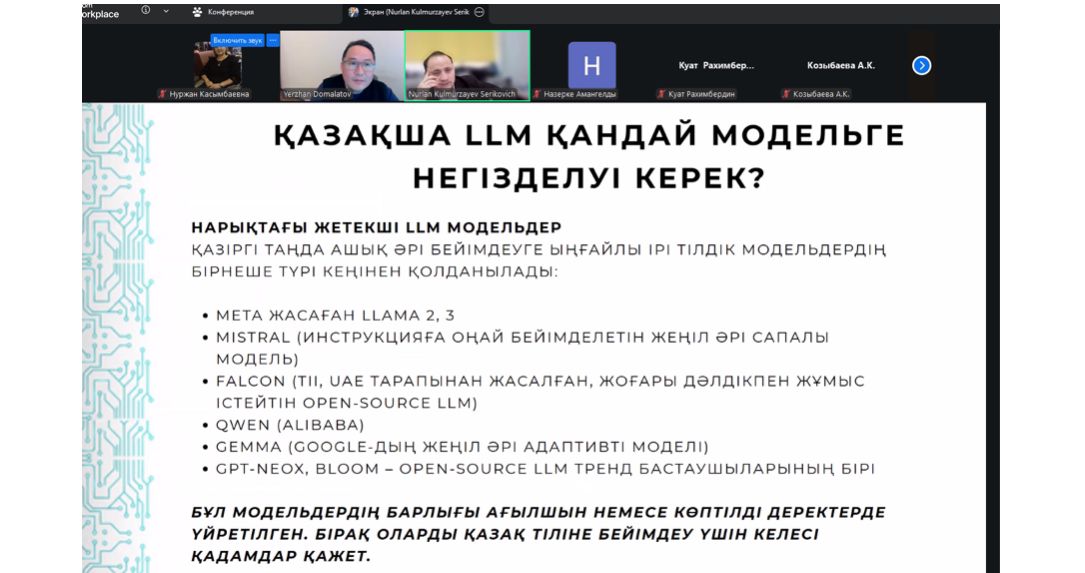
Today, as part of the Winter School dedicated to the application of artificial intelligence technologies in higher education, the third online seminar was held on the topic “Coded Culture: Principles and Models of Application for the Accurate Transmission of Cultural and Linguistic Meanings in Multilingual Artificial Intelligence Systems.”
The event was held in the format of a videoconference on the Zoom platform and brought together teachers and researchers interested in the development and implementation of artificial intelligence with due regard for cultural and linguistic diversity. The seminar speaker was Nurlan Serikovich Kulmyrzaev, PhD, Director of the Institute of Artificial Intelligence of the Non-Profit Joint-Stock Company “Korkyt Ata Kyzylorda University” in the city of Kyzylorda.
During the presentation, the concepts of coded culture in the context of multilingual AI systems were discussed, as well as the challenges and risks associated with the dominance of certain languages in the architecture of modern artificial intelligence models. Special attention was paid to the issues of preserving national and cultural identity, accurately conveying meanings, linguistic norms, and cognitive characteristics in the development and training of AI models.
The speaker emphasized that modern artificial intelligence models, despite supporting multiple languages, often rely on logical, grammatical, and semantic structures formed on the basis of the English language, which may pose a strategic challenge to the development and digital future of national languages.
The seminar generated strong interest among participants and became a platform for professional discussion on the integration of culturally oriented approaches into the design of intelligent systems, as well as on the development of AI solutions that take linguistic and cultural diversity into account.
Holding such events at Amanzholov University within the framework of the Winter School contributes to enhancing the scientific and methodological competence of the teaching staff, expanding inter-university cooperation, and forming sustainable approaches to the development of artificial intelligence in the educational and research environment.